
Outline Template
An outline is the skeleton of anything you write or present: it lets you test the order of your ideas before you commit hours to drafting. This page explains the main outline formats, walks through a worked essay outline, and describes a pack of printable and editable templates for essays, research papers, speeches, stories and presentations.
- Instant download
- Editable Word & Excel
- Print-ready PDF
- 7-day refund
8 files · PDF, DOCX, XLSX
Outline Template Pack
Printable and editable outline templates: five-paragraph and argumentative essays, compare-and-contrast, research paper, speech, story, presentation planner and blank alphanumeric and decimal outlines.
- Essay outline (PDF/DOCX)
- Argumentative outline (PDF/DOCX)
- Compare and contrast (PDF/DOCX)
- + 5 more
$5.00 USD, one-time 8 files · about $0.63 each
- Instant download
- 7-day refund
- Secure checkout by Stripe
7-day money-back guarantee. Full refund within 7 days of purchase, even after you download.
Free sample: Five Paragraph Essay Outline (PDF, 63 KB)
Outline Template Pack
Printable and editable outline templates: five-paragraph and argumentative essays, compare-and-contrast, research paper, speech, story, presentation planner and blank alphanumeric and decimal outlines.
- Essay outline (PDF/DOCX)
- Argumentative outline (PDF/DOCX)
- Compare and contrast (PDF/DOCX)
- Research paper (PDF/DOCX)
- Speech outline (PDF/DOCX)
- Story outline (PDF/DOCX)
- Presentation planner (XLSX)
- Blank outlines (PDF/DOCX)
Formats: PDF, DOCX, XLSX. Instant download after payment (link valid 72 hours, up to 5 downloads). AI-assisted: the templates were drafted with AI help and reviewed and laid out before publishing.
$5.00 USD, one-time 8 files · about $0.63 each
- Instant download
- 7-day refund
- Secure checkout by Stripe
7-day money-back guarantee. Full refund within 7 days of purchase, even after you download.
Free sample: Five Paragraph Essay Outline (PDF, 63 KB)
Full refund within 7 days — see the refund policy and license.
Free printables
Single sheets you can print right now, no sign-up. The full pack adds every sheet in one download plus the editable files.
 Printable Essay Outline Template2 pages · free PDF
 Printable Argumentative Essay Outline1 page · free PDF
 Compare and Contrast Outline Template1 page · free PDF
 Printable Research Paper Outline1 page · free PDF
 Printable Speech Outline Template1 page · free PDF
 Printable Story Outline Template2 pages · free PDF
 Printable Presentation Planner2 pages · free PDF
 Printable Outline Template2 pages · free PDF
Outline formats
| Format | Looks like | Best for |
|---|---|---|
| Alphanumeric | I. → A. → 1. → a. | School essays and research papers (the classic format) |
| Decimal | 1 → 1.1 → 1.1.1 | Technical and business documents; easy to see depth |
| Full-sentence | Every point is a complete sentence | Detailed plans that turn quickly into paragraphs |
| Topic (phrase) | Short phrases only | Quick brainstorming and speeches |
| Reverse outline | Summarise each paragraph of a finished draft | Checking structure while revising |
In the alphanumeric format, Roman numerals mark main sections, capital letters mark supporting points, Arabic numerals mark details, and lowercase letters mark sub-details. A traditional rule is that if you have an A you should have a B — a single sub-point usually belongs in its parent.
Five-paragraph essay outline
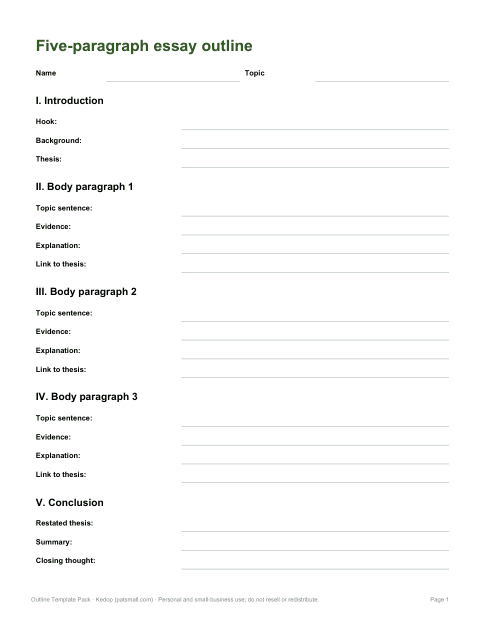
- I. Introduction — hook, background, thesis statement listing three points
- II. Body paragraph 1 — topic sentence, evidence, explanation, link to thesis
- III. Body paragraph 2 — topic sentence, evidence, explanation, link
- IV. Body paragraph 3 — topic sentence, evidence, explanation, link
- V. Conclusion — restate thesis in new words, summarise points, closing thought
The structure scales: a longer essay keeps the same introduction–body–conclusion shape but adds more body sections, each with its own topic sentence.
Worked example: argumentative essay
| Level | Content |
|---|---|
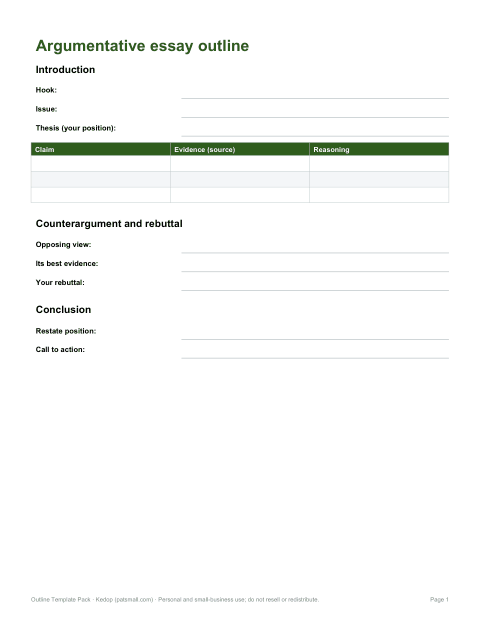
| I. Introduction | Hook: most students carry a phone all day. Thesis: schools should teach phone-free study habits rather than ban phones outright. |
| II. A. Claim 1 | Bans are hard to enforce and move the problem elsewhere. |
| II. B. Evidence | Summary of a school policy report or survey (cite the source) |
| III. A. Claim 2 | Taught habits transfer to university and work. |
| IV. A. Counterargument | Bans reduce distraction in class. |
| IV. B. Rebuttal | Structured phone-free periods achieve the same benefit while teaching self-control. |
| V. Conclusion | Restate thesis, call for a pilot programme. |
Notice the counterargument and rebuttal section: argumentative outlines are stronger when they address the other side directly. The evidence rows are placeholders — in real work, cite actual sources.
Research paper outline
- Title and working thesis — a question or claim you can refine as you research.
- Introduction — context, why the topic matters, thesis, roadmap.
- Literature review / background — what sources already say, grouped by theme.
- Methods (for empirical papers) — how evidence was gathered.
- Findings or main argument — sections with sub-points and citations.
- Discussion — interpretation, limitations, counterarguments.
- Conclusion — answer to the research question and implications.
- References — in the style your course requires (APA, MLA, Chicago).
Add source notes to each point as you outline — writing “(Smith 2021, p. 14)” next to a point saves hours when drafting.
Speech and presentation outlines
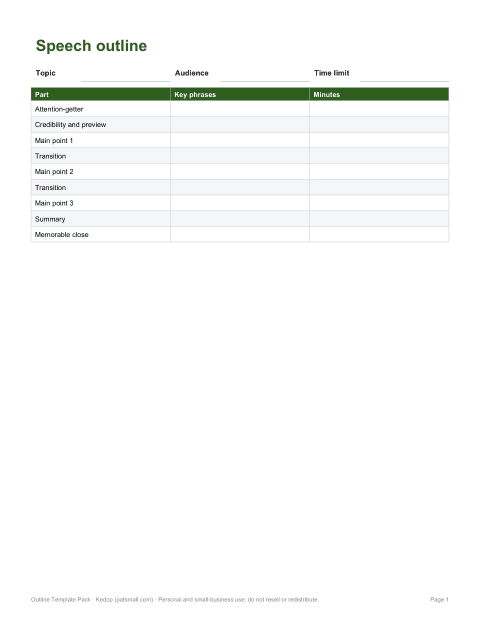
A speech outline is usually shorter than an essay outline and uses key phrases rather than sentences, so you can glance at it while speaking. A common structure is: attention-getter, credibility and preview, three main points with transitions, summary, and a memorable close. For presentations, map one main point to one slide or group of slides and add timing to each section — the pack’s presentation template includes a minutes column so the total fits the time limit.
Story and novel outlines
| Structure | Beats |
|---|---|
| Three-act | Setup → confrontation → resolution |
| Freytag’s pyramid | Exposition → rising action → climax → falling action → resolution |
| Hero’s journey (simplified) | Ordinary world → call → trials → ordeal → reward → return |
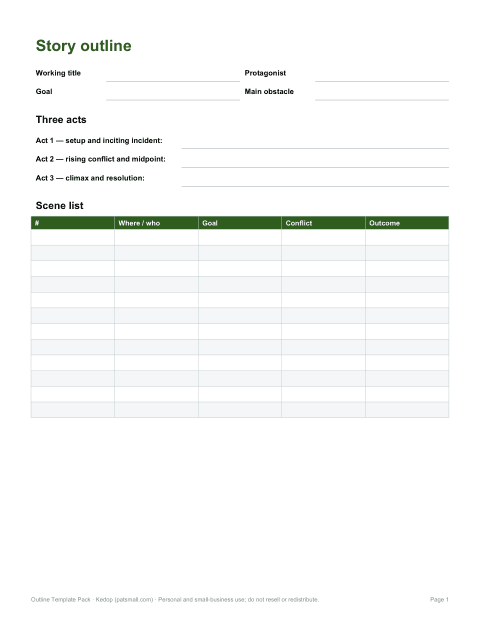
| Scene list | One line per scene: who, where, goal, conflict, outcome |
Writers differ: some outline every scene, others only key turning points. A simple scene list is often the most useful middle ground.
What’s in the pack
- Five-paragraph essay outline (PDF/DOCX)
- Argumentative essay outline with counterargument section
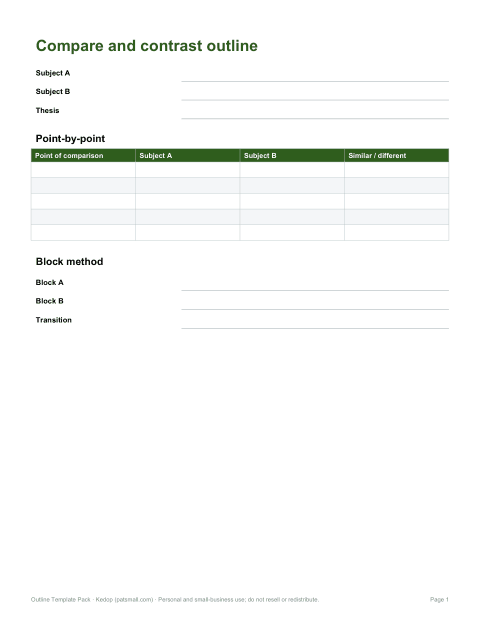
- Compare-and-contrast outline (block and point-by-point)
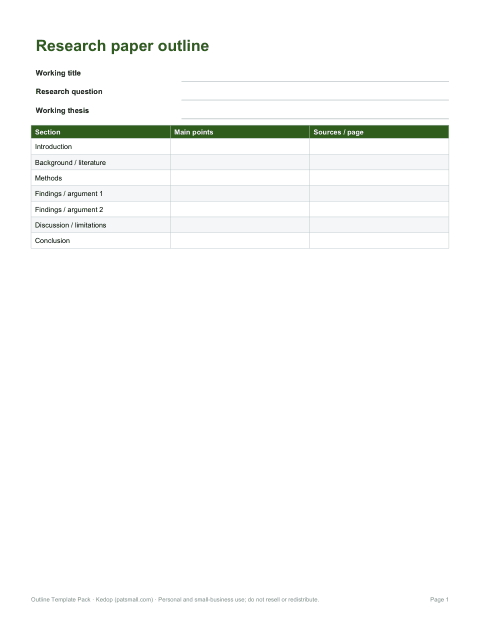
- Research paper outline with source-note columns
- Speech outline with timing and transitions
- Story outline (three-act and scene list)
- Presentation planner (XLSX) with automatic total time
- Blank alphanumeric and decimal outlines
Documents print on US Letter and A4; DOCX files open in Word or Google Docs so you can type straight into them.
AI-assisted content
Templates were drafted with AI assistance and reviewed before publishing. Always follow your teacher’s or publisher’s specific formatting requirements.
Frequently asked questions
What is an outline template?
A pre-structured document that helps you organise ideas into sections and points before writing.
What are the parts of an essay outline?
Introduction with thesis, body sections with topic sentences and evidence, and a conclusion.
What is the difference between a topic and a sentence outline?
A topic outline uses short phrases; a sentence outline writes each point as a complete sentence.
What is a decimal outline?
An outline numbered 1, 1.1, 1.1.1 — common in technical and business writing.
Can I edit the templates?
Yes, the DOCX and XLSX files are editable in Word, Excel or Google Docs and Sheets.
Is this a subscription?
No, it is a one-time download.